


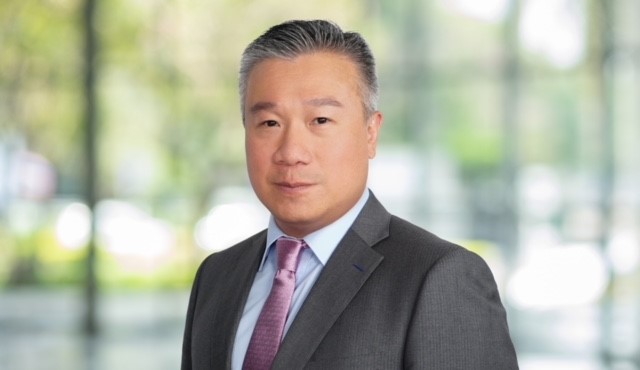
Christopher Jung
Head of Asia Prime Brokerage and Outsourced Trading

Massimo Labella
Co-Head of International Prime Brokerage and Outsourced Trading

Bobby Croswell
Co-Head of Americas Prime Brokerage and Outsourced Trading


If 2024 was the year outsourced trading proved it could scale, 2025 was the year it showed just how quickly a market can shift. The new Outsourced Trading Handbook 2025 by The TRADE landed on desks this month, offering a detailed snapshot of the market. Its findings confirm a sector that has survived a few shocks over the past 12 months, broadened its footing and continued to mature.
Across New York, London and Hong Kong, three of Marex’s outsourced trading leaders – Bobby Croswell, Massimo Labella and Chris Jung – have watched those shifts up close. To unpack what this year really meant for the buy side, and what to consider as we head into 2026, we explored some of the key themes.
What this year revealed about the model
The UBS withdrawal set the tone early. “It was a challenging moment for a lot of firms,” reflects Bobby. “When a provider of that scale steps away, clients have to make rapid, high-stakes decisions. It reminded everyone how critical long-term alignment is.”
BNP Paribas’ later decision to step back from external clients underscored the same point across Europe and Asia. Massimo says: “Events like this highlight how important it is that outsourced trading sits within a business model built to support it over the long term.”
Despite the headlines, confidence in outsourced trading kept building. Fully outsourced setups climbed to 51%, up from 47% last year, according to The Trade’s research, marking a third year of steady growth. Notably, ratings from the largest asset managers were above industry satisfaction, underscoring the model’s strength among the most sophisticated users.
A broader trend: why the buy side continued to lean into outsourcing
Beyond specific events, 2025 reinforced the key drivers pulling firms toward outsourced trading.
Operational pressure topped the list: 75% of respondents cite operational inefficiency as a primary reason for outsourcing, marking its third year as the primary motivator. This is followed by the need to pursue growth while controlling costs (40%) and the search for a fit-for-purpose operating model (37%).
“Firms are stretched,” says Chris. “They’re trading across more asset classes, time zones and market structures, but the inflow of talent hasn’t kept pace. Outsourced trading allows them to scale without carrying the whole operational load internally.”
Talent constraints continue to influence, with 37% ranking hiring concerns as a top driver, consistent with broader industry studies on the challenges in hiring experienced traders. Massimo adds: “It’s not just about adding headcount. It’s the depth of experience needed to handle today’s complexities, and that’s becoming increasingly difficult to build internally.”
According to Marex, increased operational complexity is also driving uptake.The challenges of multi-market execution, fragmented liquidity and rising compliance workloads all point to a trading environment that is materially harder to manage in-house.
Custodians broaden the supplier landscape and sharpen focus on structure
Another development this year was the increasing visibility of custodians offering outsourced trading services. Their model – positioning trading as a natural extension of established middle- and back-office services – naturally appeals to firms that prize continuity and scale.
It hasn’t displaced other models, but it has encouraged firms to look more closely at the differences amongst providers. Bobby emphasises. ““Custodians bring scale and integrated infrastructure. Independent agency desks bring neutrality, flexibility and a more tailored, client-centred service model. Managers are mapping those characteristics to what matters most for them.”
Clients are also showing greater interest in how providers handle routing, conflicts, incentives and operational independence; not out of distrust, but because structural differences influence how the service works day to day.
Chris adds: “Integrated models make sense for some firms. Others want a desk that mirrors their internal team; same thinking, same workflow, same alignment. The variety of options is a strength of the ecosystem, as long as everyone is transparent.”
In this environment, desks that combine buy side alignment with institutional resources – without being tied to a single execution or custody framework – are increasingly seen as a pragmatic middle ground.
Read ‘Built to fit: the DNA of a buy-side outsourced trading desk published by The TRADE’
What clients valued in 2025: neutrality, consistency and depth
The Trade’s research also highlighted that firms are increasingly scrutinising the qualities that shape day-to-day execution.
Execution and Coverage again emerged as the top selection factors across the provider charts, highlighting the premium managers place on reliable market access. “2025 was a year where liquidity wasn’t straightforward,” Massimo notes. “When markets move unpredictably, the depth of your broker network, the experience of your traders and your ability to source liquidity across venues become visible very quickly.”
Clients also paid closer attention to routing, conflicts and overall execution approach. As Bobby explains, “We had far more conversations about routing philosophy and execution approach. Clients want to understand how the process aligns with their own trading style.” The PM–trader relationship, strong trader-to-client ratios and senior traders who can understand and anticipate their needs also featured strongly in these discussions.
Multi-asset capability is also a recurring theme in client discussions. As more firms trade across regions and increasingly complex product sets, they want a desk that can support global workflows without fragmenting their approach. “Clients want one desk that understands how they trade across everything, and they want that experience to be consistent whether they call London, New York or Hong Kong,” says Chris.
Marex’s position in the 2025 survey: three years of consistent strength
Against this backdrop, Marex’s 2025 survey results reflect a stable and well established model..
According to The TRADE’s commentary: “What a year it has been for Marex… The M&A growth has been complimented by the addition of talent across the globe and a slew of new partnerships, marking a landmark 12 months for Marex.”
Marex recorded the highest number of client responses in the survey, indicating strong engagement across its client base, and performed above the global benchmark in all categories.
Execution was again a standout amongst Marex’s clients, who highlighted broker panel quality, order routing and anonymity / disclosure of order flow as positives. Cost vs Value is a challenging category across the industry, however for Marex it remained strong due to flexible and transparent pricing structures.
Most notably, 82% of Marex’s clients rated the firm’s overall service as ‘Very Good’ or above – the highest since the survey began.
Bobby highlights: “The desk was built for the buy side from the beginning, and that mindset still underpins how we operate. We’ve expanded our geographic reach, strengthened our multi-asset capabilities and invested in senior talent, but the cultural DNA hasn’t changed. That neutrality and continuity matters to clients.”
Looking toward 2026: a model choice becomes more consequential
All three Marex leaders expect 2026 to be another demanding year. Demand in Europe and Asia continues to rise, and competition among providers remains intense.
Massimo observes: “In Europe we’re seeing more managers launching with global mandates from day one. That changes what they need from a trading partner. They want global workflows, multi-asset capability and operational reassurance.”
Looking ahead, the market will continue to evolve along three broad models: custodian and other institutional execution teams, independent boutique and the space in the middle – the institution-backed buy side aligned desks. The distinctions will become more visible.
Liquidity will remain uneven. Market structure innovation will continue at pace. Regulatory cycles will tighten, firms will face increasing workflow pressure, and clients will keep scrutinising provider structure as closely as capability.
As Bobby explains “Clients are thinking longer-term about how their trading setup needs to evolve, and which model is genuinely built to support that.”
And Massimo concludes: “The past year reminded everyone that stability, independence and global capability all matter. Providers who can balance those strengths will be the ones setting the benchmark in 2026.”